
For Christmas 2026, post your letter to Santa between 19 November, the opening date of La Poste's Santa's Secretariat, and 20 December, the final day for posting. Aim for 15 December instead: the reply then arrives before Christmas Eve, with no race against the clock.
Deadline for posting your letter to Santa in 2026: what's confirmed
Santa's Secretariat, set up by La Poste at its workshop in Libourne, in the Gironde region, opens on 19 November and accepts letters until 20 December. Between these two dates, around sixty postal elves take turns opening envelopes and sending a reply to every child.
The official dates announced by La Poste
These dates are the ones communicated by La Poste Groupe for the reopening of Santa's Secretariat. They follow the same pattern as previous seasons: in 2025, the service had already opened on 19 November, as reported by CNews on opening day.
A useful habit before sealing the envelope: check the official website pere-noel.laposte.fr, which displays the current season's calendar. Many pages found online simply recycle dates from one year to the next without updating them, which explains the conflicting information you'll come across in November.
Why aim for 15 December rather than the closing date
20 December is a receipt date, not a posting date. A letter posted on the evening of the 19th, in a box already collected, risks arriving after the workshop closes, and December post volumes are far higher than at any other time of year.
By sending it before 15 December, you keep a few days' margin for the outbound journey, processing in Libourne, and the return trip. The reply then ends up unwrapped under the tree, rather than discovered in late December, by which point no one's interested any more.
The countdown schedule from November to December, week by week
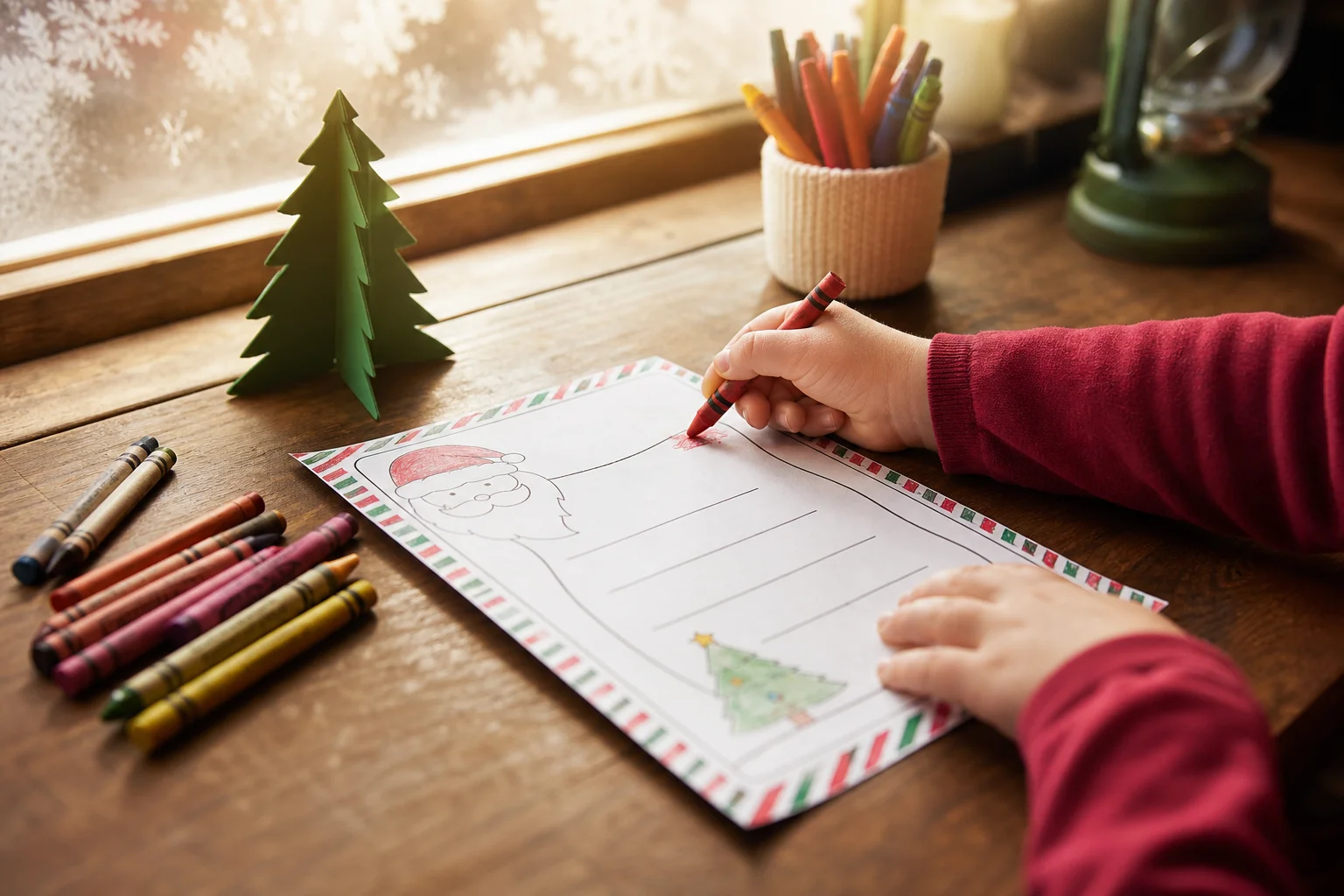
A 5 year old doesn't write their letter in ten minutes: between the drawing, the crossing-out and the last-minute change of mind, allow for several evenings. This calendar spreads the task out instead of cramming it into one rainy Sunday.
| Period | What you do | Why this date |
|---|---|---|
| Early November | Get the child talking about what they want, jotting down ideas as they come | Wishes settle down, so you avoid a list dictated by the last advert seen |
| Week of 19 November | Write the letter and post it as soon as the Secretariat opens | The letter arrives before the early-December rush |
| Late November | Copy the gift list on your side and share it with the family | Grandparents order early, often as soon as Black Friday |
| Before 15 December | Last comfortable window for posting | Allows time for the outbound trip, processing and the return |
| 20 December | Cut-off for receiving letters | After this date, no more replies are sent for the season |
This sequencing also solves a very concrete problem: the letter written at school that you find at the bottom of the school bag on 21 December. If the subject was raised at home from November onwards, the envelope will have been sent long before.
How long it takes to receive Santa's reply
Santa's reply isn't instant: it depends on two postal journeys plus processing time in Libourne. Allowing around ten days between posting and receiving avoids the daily "has he replied yet?" on the way home from school.
The delivery time to factor into your calculations
A Lettre verte (green letter, the standard French second-class post) is delivered within 3 working days in mainland France, an indicative time given by La Poste's online help centre. Apply this twice, for the outbound and return journeys, then add the time needed for sorting: a realistic range is around a week to ten days during quieter periods, and longer as 20 December approaches.
Another variable: public holidays and weekends, which don't count as working days. A letter posted on a Friday evening in December doesn't start travelling until the following Monday.
The condition parents often forget: the address on the back
No stamp is needed and the service remains entirely free: simply writing "Père Noël" on the envelope is enough for it to be directed to the Secretariat. However, without the child's full address on the back, the elves have nowhere to send a reply.
So check three things before slipping the envelope into the box: the child's first name, their full postal address, and the postcode, written clearly on the back. This oversight is the leading cause of replies that never arrive, well ahead of posting too late.
Too early, too late: the two calendar traps
Posting in October and posting on 22 December cause the same problem, for opposite reasons: in both cases, the letter falls outside the processing window.
A letter posted before the Secretariat opens
The elves only arrive at the workshop from 19 November onwards. An envelope posted in mid-October sits waiting its turn in the postal system, with no guarantee it'll join the first day's pile.
If your child writes early, keep the letter at home. This wait can actually become a pleasant ritual: re-reading it, adding a drawing, swapping one toy for another, then posting it together on opening day.
Catch-up solutions after the deadline
After 20 December, paper letters will no longer be processed for the season. There's still the digital letter available on the Secretariat's website, where the child personalises their message by clicking "Écrire au Père Noël": the online format avoids delivery uncertainties and gives an immediate result on screen.
A home-based fallback, valid at any time: write the letter anyway, read it aloud, then leave it by the tree on the evening of the 24th. The tradition holds up perfectly well without La Poste's stamp, and the child doesn't experience the missed deadline as a failure.
From the letter to Santa to the shared gift list
The letter says what the child wants; the list tells the family who's buying what. The two complement each other, and the second is prepared at exactly the same time, in late November, while wishes are still fresh in mind.
Copy the ideas from the letter into a free Christmas list to share, then send the link to grandparents, godparents and the rest of the family. Everyone can see what's already been claimed, without knowing what others have chosen for them, which rules out the scenario of two identical games consoles being unwrapped five minutes apart.
To structure the exercise with younger children, our guide on children's Christmas lists explains how to sort between one big gift and several smaller ones. When siblings, cousins and grandparents all get involved, organising a family Christmas list avoids messages flying back and forth in every direction. And if the letter amounts to three vague lines, browse our Christmas gift ideas by age and interest to get the conversation going again.
Why a deadline has existed since 1962
Santa's Secretariat was created in 1962 by Jacques Marette, then France's Minister for Posts and Telecommunications, continuing an initiative started by postal workers in the 1950s. The very first reply card was written by Françoise Dolto, paediatrician, psychoanalyst, and sister of the minister.
The closing date reflects a simple industrial constraint: volume. The French Secretariat receives more than 1.2 million letters each season, processed by around sixty postal elves. By comparison, Swiss Post processed 31,034 letters during Advent 2025 with a team of eight elves, according to 24 heures.
Closing on 20 December gives the elves time to clear the last batch before Christmas Eve. Without this cut-off, thousands of children would receive their card in early January, long after the tree had come down.
Frequently asked questions about when to send the letter to Santa
Does Santa reply to every letter?
Every letter received between 19 November and 20 December gets a reply, on one condition: the child's full address must appear on the back of the envelope. Without legible contact details, the elves in Libourne can't send anything back. The service doesn't select or filter letters and asks for no proof of anything. Write the first name, house number and street name, postcode and town, using a ballpoint pen rather than a felt tip, which smudges in damp conditions.
Do you need a stamp to write to Santa?
No. Sending the letter is free, with no stamp or special postage required. Writing "Père Noël" on the envelope is enough for it to be directed to the Secretariat, even if your child has written a made-up address like "North Pole". This has been the case since the service began and applies to letters sent from within France. The reply also arrives free of charge in your letterbox.
What should you do if you've missed the 20 December deadline?
Paper letters are no longer processed after this date, but the digital letter available on the Secretariat's website remains an immediate option: the child composes their message online and gets a result straight away, without waiting for the postman. Another, purely family-based option: leave the letter by the tree on Christmas Eve. For next season, make a note of mid-November, when the Secretariat reopens.


Comments 0
No comments yet. Share your experience!
Leave a comment