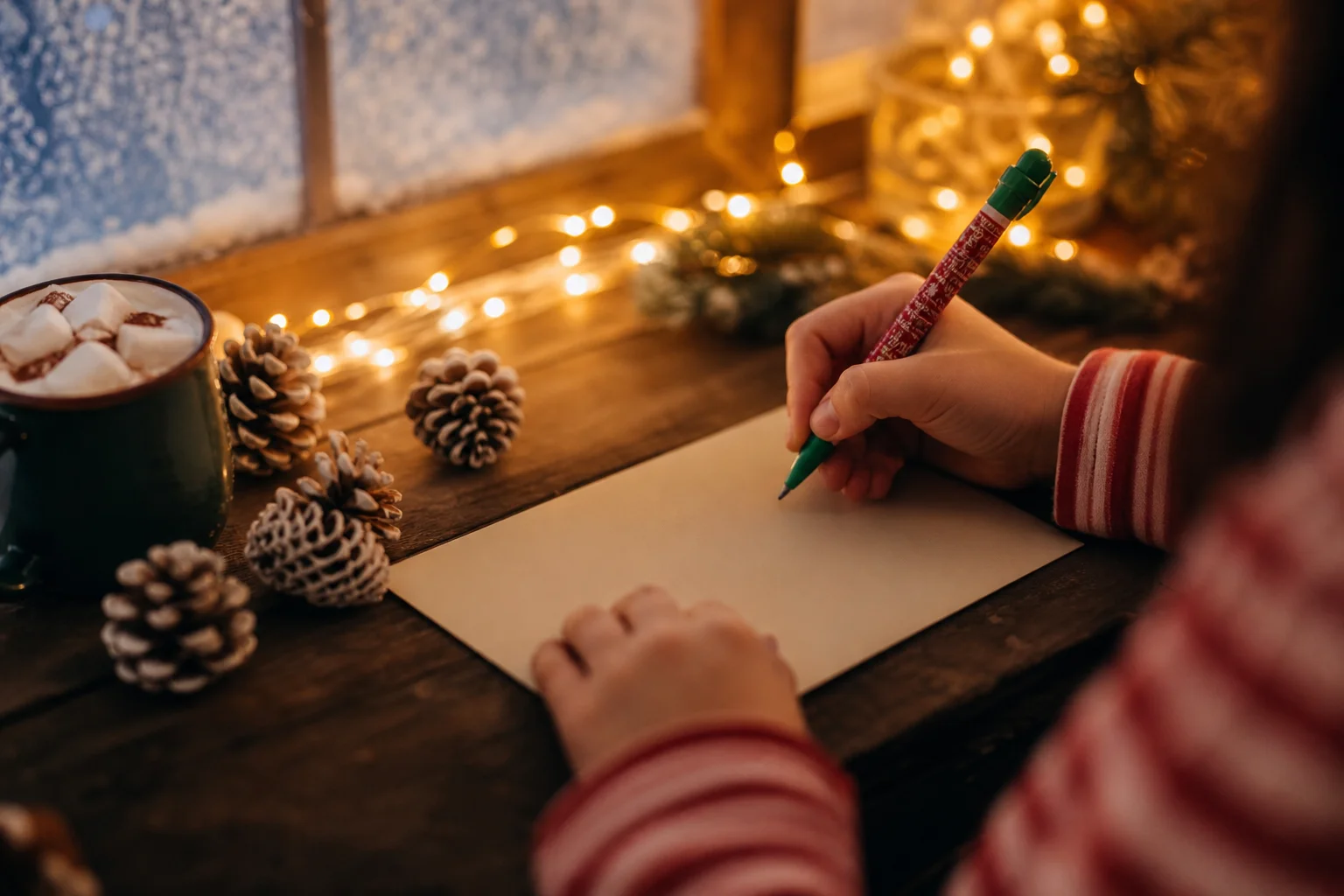
A letter to Santa needs no stamp when sent to "Santa, 33500 Libourne, France". Writing "Santa" is enough on the envelope: France's postal service, La Poste, delivers the mail straight to his workshop in Libourne, in the Gironde region. For a reply to arrive before Christmas, write your address on the back and post the letter from mid-November onwards.
Santa's official address in 2026, exactly as it should be written on the envelope
The address fits on three lines, with no street number and no PO box. On La Poste's official letter template page, the service confirms that a letter addressed simply to "Santa" reaches its destination and requires no postage. This free delivery applies to letters posted in France, in any yellow letterbox.
The front: the recipient's name is enough
Have your child write, in large letters, in the centre of the envelope:
- Santa
- 33500 Libourne
- France
Nothing else. No stamp, no "Cloud Street", no fanciful barcode drawn in felt-tip in the corner: the automatic sorting machines read the postcode, and the letter is forwarded to the workshop from there. A standard white envelope works perfectly well, even if glittery paper is tempting. Stickers hold up better than loose glitter, which tends to fall off inside the sorting machines.
The back: the return address, the one line that triggers a reply
This is the detail almost every downloadable template forgets. A letter with no sender's details still arrives safely in Libourne, but it can't receive any reply. So write clearly on the back of the envelope: the child's first and last name, house number and street name, any additional details (building, floor), postcode and town. Check this part yourself, even if the child holds the pen. An incomplete address means a reply that will never come, and a disappointment that's hard to fix on 23 December.
Who really reads these letters
Santa's workshop has existed since 1962, when France's postal administration decided to answer children's letters rather than throw them away; psychoanalyst Françoise Dolto helped write the very first replies. Today, in Libourne, 60 elves open, sort and answer the mail, according to La Poste Groupe. The scale is staggering: the 2024 season saw 1.2 million letters come through, according to France Bleu in November 2024.
The letter to Santa template to print: 6 sections to fill in
A useful template isn't a pretty empty frame, it's a structure that guides the child from the first line right through to the signature. Copy this skeleton onto an A4 sheet, or print it out leaving wide gaps between lines for beginner handwriting.
The skeleton to copy word for word
- The heading: "Dear Santa," followed by the place and date ("Nantes, 22 November 2026").
- The introduction: first name, age, town, and a personal detail (school, little brother, the cat).
- The year gone by: two or three lines about what the child is proud of since going back to school.
- The wishes: three ideas maximum, described precisely, listed in order of preference.
- A note for the reindeer: a question, a drawing, a kind thought for their journey on 24 December.
- The closing line: "Lots of love", the child's name signed by hand, and the address repeated below the signature.
Three wishes, not fifteen. A never-ending list dilutes what the child really wants and makes life harder for the adults reading over their shoulder. If inspiration is lacking, or if everything boils down to "my friend's console", browse our Christmas gift ideas guide together before writing the final version: the letter will feel far more genuine.
The three sentences that make all the difference to the elves
Replies from the workshop are personalised based on what the child shares. A letter reduced to a list of toy references leaves little to work with. So encourage three specific sentences: what the child learnt this year, what made them happy, what they wish for someone else. These don't change how the letter is processed, but they turn an order form into a real letter. And ten years from now, they make for a far more moving family keepsake than a screenshot of an online shopping basket.
Adapting the letter by age: 3-5, 6-8, 9-11 years old
The exercise looks completely different depending on whether the child draws, is learning to read, or can write independently. The table below sums up the best format and the parent's role, which fades over the years without ever fully disappearing.
| Age | Format of the letter | Parent's role |
|---|---|---|
| 3-5 years | Captioned drawing, a few copied words, catalogue cut-outs pasted in | Dictation to the adult: write down exactly what the child says, without correcting their phrasing |
| 6-8 years | Short handwritten text, 6 to 10 lines, imperfect spelling accepted as is | Only check the return address, help sort out the wishes |
| 9-11 years | Letter written entirely independently, sometimes with a touch of humour | Step back completely on content, just keep an eye on the posting date |
With younger children, taking dictation avoids the classic trap: a parent who rephrases things and ends up with an adult's letter. Write down the exact words, however wobbly. Around age 9 or 10, many children still write even as doubt creeps in; the letter becomes a shared game, and that's perfectly fine. For this age group, our selection of gift ideas for a 10-year-old girl offers concrete suggestions when the wishes get vague. When several children are writing on the same evening, keeping a separate Christmas list per child stops the requests getting mixed up.
When to post the letter to get a reply before Christmas Eve
Timing is everything: too early, and the workshop's letterbox hasn't even been emptied yet; too late, and the reply arrives after the tree has already come down. In practice, the useful window runs from mid-November to mid-December.
Santa's workshop opening dates
In 2025, the workshop operated from 19 November to 20 December, according to La Poste Groupe. For the 2026 season, La Poste had not yet published its calendar by late September: the exact dates are usually confirmed in autumn on the operator's website. Historically, the workshop opens in mid-November, a few days before the first door of the Advent calendar. Keep this rule of thumb in mind: a letter posted in the week after opening leaves plenty of time for a reply to come back. Watch out for pages still showing dates from a previous season, a common mistake in November.
Writing from abroad or getting started late
From another country, the same address works as long as you add "France" as the last line and apply postage according to your local postal rules, since free delivery only applies to letters posted within France. International delivery times mean you should allow for an extra week either way. Already past 15 December? Switch to the faster online form, or accept that the reply will arrive between Christmas and New Year: at this age, a letter addressed personally in the letterbox is still a special moment, even a little late.
From the letter to the shared list: the online version and the family
The letter belongs to the child. Organising the gifts, on the other hand, belongs to the adults, and the two are best kept separate.
La Poste's online form
The service pere-noel.laposte.fr lets children write directly online: with an adult's help, the child fills in the form and then receives a letter from Santa along with a postcard to colour in, according to La Poste Groupe. The activation date for the 2026 season form was not known as of late September. This option is handy for expat families, families in a hurry, and children who can't yet write on their own: the message is typed, but the reply still arrives on paper.
What the letter doesn't tell the grandparents
A letter sent off to Libourne tells nobody what's left to buy. The classic result on 25 December: two copies of the same board game, and a disappointed aunt who bought a duplicate. Take a photo of the letter before posting it, then copy the wishes into a free Christmas list to share that you send to grandparents, godparents and other relatives. Everyone can see what's already been bought without knowing exactly who bought what. For siblings and large family gatherings, a family Christmas list keeps all the requests in one place, on the adults' side, away from the child's eyes.
Three questions parents often ask
Does Santa reply to every letter?
The workshop aims to reply to every letter that includes a clear, complete return address within France. These details, written on the back of the envelope or under the signature, are what make a reply possible. An anonymous letter, an illegible address or an incorrect postcode breaks the chain. So check the back of the envelope yourself before it goes into the letterbox, even if that means going over the numbers in pen on top of the child's writing.
Can you write to Santa from abroad?
Yes. The address remains "Santa, 33500 Libourne, France", with the country added as the last line for international delivery. Free postage applies to letters posted within France: from abroad, you'll need to pay postage according to your own country's rates. Allow an extra week of transit time in each direction and post accordingly, or use La Poste's online form, which removes the constraint of postal delivery times.
From what age can a child write to Santa?
There's no minimum age. From age 3, dictating to an adult works really well: the child tells the story, you write it down, and they sign with a drawing or their name in capital letters. Around age 6, they can write a few lines themselves. At 10 or 11, many children keep going simply for the fun of the tradition. The letter doesn't need correct spelling or neat handwriting, just an accurate return address.
Comments 0
No comments yet. Share your experience!
Leave a comment