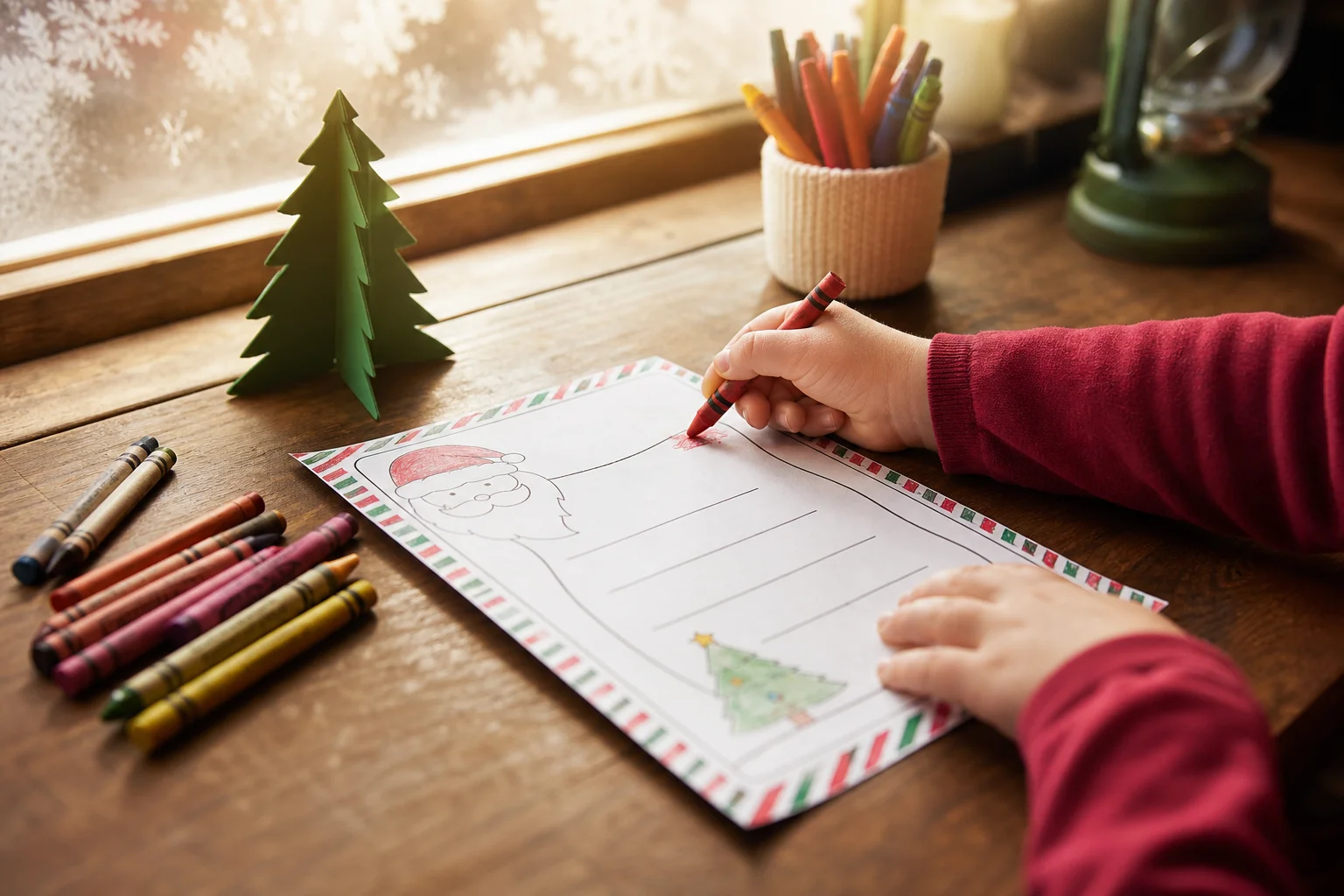
A letter to Santa template for nursery school fits into six short blocks: the date, the greeting, a sentence about the year gone by, two or three wishes, a small promise, and the signature. The child dictates, the adult writes, and a drawing replaces the text the child can't yet write. It all fits on a single sheet.
The six blocks of a letter to Santa template suited to nursery school
A successful nursery letter fits on half a page: the longer the text, the more the child loses focus before the end, and the dictation ends up becoming the adult's own words. Keep these six blocks in order, they're enough to produce a complete letter.
- The date and town, written by the adult in the top right corner.
- The greeting: "Dear Santa,"
- The introduction: first name, age, name of the school or class.
- A proud moment from the year: something the child learned to do by themselves.
- The wishes: two or three gifts, no more.
- The closing line and signature, with a drawing at the bottom of the page.
The short template to copy as it is
Copy this fill-in-the-blanks text onto a blank sheet or a bordered page, then fill in the brackets with the child's exact words.
Dear Santa, My name is [first name], I am [age] years old and I go to nursery school in [town], in [teacher's name]'s class. This year, I learned to [ride a bike / put my shoes on by myself / count to ten]. I would really like [gift 1], [gift 2] and [gift 3]. I'll leave you [a biscuit / a glass of milk] near the tree, and a carrot for the reindeer. Lots of love, [first name]
The closing line deserves a quick negotiation: "lots of love", "see you soon" or "thank you Santa" sound natural coming from a 4-year-old. Formal phrases have no place here, and a child who doesn't understand what they're dictating loses track of their letter.
Three gifts maximum: why we limit the request
A list of twelve toys doesn't help anyone, least of all the child. Between ages 3 and 6, the concept of choice is still developing: asking for two or three items forces the child to prioritise their wishes, which remains the most useful part of the whole exercise. On the family side, a tighter letter gives parents, godparents and grandparents a clear starting point for what to buy. Ask the child to name five ideas out loud, then keep the three favourites for the letter. The others aren't lost, they'll join the shared Christmas list mentioned further below.
Which template for which age group: toddlers, middle group, older children
The same text isn't written the same way for a 3-year-old as for a 6-year-old, because the gap in writing skills between these ages is considerable. Split the tasks according to this table.
| Age group | What the child writes themselves | What the adult takes care of |
|---|---|---|
| Toddlers (ages 3-4) | The drawing, some stickers, a few marks under the text | The entire text, written as dictated |
| Middle group (ages 4-5) | Their first name in capital letters, the drawing | The body of the letter, the date, the envelope |
| Older children (ages 5-6) | Their first name, one or two recognised words (SANTA, MUM), early writing attempts | Longer sentences, spelling, reading aloud for review |
Toddlers: the drawing comes first
At age 3, the drawing carries the message. Have the child draw the gift they want before any writing takes place: the drawing supports the spoken word, the child comments on their drawing and you note down their words as they go. Two dictated sentences are plenty. Add a caption under the drawing ("a red fire engine"), that's what the child will read back with you in the evening. Avoid overly decorated colouring letters: a large blank sheet and three felt-tip pens hold attention better than a page covered in printed garlands.
Middle group: the first name in capital letters
The middle group is the age of the signature. The child writes their first name in capital letters, at the bottom of the letter, with or without a model depending on their skill level. Don't erase or trace over it: a wobbly letter written alone is worth more than a perfect first name achieved hand in hand. You can also let them write a short word they already know, like SANTA. You write the rest of the text while they speak, saying out loud what you're writing so they can connect their sentence to the line appearing on the page.
Older children: early writing attempts
In the final year of nursery, the curriculum aims for a specific goal: writing their first name in cursive, without a model, after learning to write it in capital letters (early years curriculum, Official Bulletin no. 41 of 31 October 2024). Make the most of it: the child can sign in cursive, copy out "Dear Santa" and try to write the name of a toy by themselves, using the letters they hear. These attempts, even if imperfect, are encouraged in class. Let the different styles of writing coexist on the page, capitals, cursive and invented spelling: no one will correct Santa on that point.
Adult dictation: the method teachers use to write the letter
Adult dictation is the way a child who can't yet write produces a piece of writing: they compose their message out loud, the adult writes it down in front of them, phrasing it the way one writes rather than the way one speaks. This practice serves one of the goals of the early years curriculum: beginning to produce written texts and discovering how writing works. The letter to Santa is the most natural opportunity of the year to do this.
Three steps: talk, sort, write
Start with a free-flowing conversation, no paper involved: what do you want to tell Santa? This preliminary spoken phase is the most important, and it's often the one that gets skipped. Next comes sorting: out of everything that was said, what do we keep? The child chooses, you rephrase out loud ("so I'll write: I would really like a tractor"). Writing comes last, slowly, rereading each finished sentence. This rhythm, talk then sort then write, produces a text the child recognises as their own.
What spoils the dictation
Three adult reflexes ruin the exercise. Suggesting ideas first: if you propose the gift, the letter becomes yours. Correcting the vocabulary afterwards: "my bunny comforter" is worth more than an elegant rephrasing the child won't recognise when reading it back. Lengthening the text out of fear it will sound thin. A six-line letter dictated by a 4-year-old is exactly what it should be. Keep control only over the written syntax: you turn "um, the thing that rolls over there" into a readable sentence, with the child's approval.
Writing the letter to Santa with a whole nursery class
A class can write a collective letter, and the exercise fits the curriculum perfectly: spoken language, written production, discovering functional writing. The letter becomes a week-long project rather than something thrown together at the end of the morning.
One collective letter, one drawing per child
The principle works in two stages. During circle time, the children dictate the body of the letter together, sentence by sentence, while the teacher writes on the board or on a large poster. Each child then does their own drawing and signs their first name on a small card attached to the letter. The envelope is sent in the class's name, with the school address on the back. A simpler variation for younger groups: a very short individual letter per child, two dictated lines and a drawing, all slipped into one large shared envelope.
Check the current year's arrangements
The sending conditions and reply formats change from one year to the next. Before starting the project in class, check the official Santa's office website, pere-noel.laposte.fr, for opening dates, paper or digital sending options and the resources offered to schools that year. Also let families know: a child who gets a reply at school and nothing at home is bound to ask questions.
Posting the letter: envelope, stamp and address on the back
La Poste's Santa service is free: an envelope marked "Père Noël" is sent without a stamp to the processing centre in Libourne, in the Gironde region of France. Write the child's full name and address on the back, otherwise no reply will be able to reach them.
Timing matters: in 2025, the office operated from 19 November to 20 December, and the dates change every year. Post before mid-December rather than after, the reply will arrive that much sooner. For details on the envelope, accepted address formats and a template suited to older children, see our article on Santa's official address and the classic template.
After the letter: turning dictated wishes into a shared Christmas list
The letter is sent, but the wishes remain. Write down straight away, before sealing the envelope, the five or six ideas that came up in conversation: the chosen tractor, but also the board game mentioned in passing and the costume brought up while drawing. These notes will come in handy when an aunt calls on 10 December. Add them to the children's Christmas list, with useful details (size, colour, version of the toy), then set up a free Christmas list to share with grandparents, godparents and family friends. Everyone can see what's already been reserved without the child knowing, which also solves the problem of three identical puzzles ending up under the tree. Our no-duplicate method explains how to split gifts between families.
Frequently asked questions
At what age can a child write their own letter to Santa?
Later than you might think, and that's perfectly normal. By the final year of nursery, a child can write their first name and attempt a few short words, but they can't yet produce a connected piece of text on their own. Writing a full letter, with complete sentences and approximate but readable spelling, comes after this stage. Until then, adult dictation remains the right method: it separates what the child can already do, think and express, from what they can't yet do, which is forming letters.
What if the child asks for an impossible gift?
Don't censor the letter during dictation: a child who sees their request crossed out understands that the adult decides on Santa's behalf. Write the wish down, then mention while reading it back that Santa chooses from the list himself and can't bring everything. Repeating this calmly helps avoid disappointment on 25 December. For unrealistic requests (a real pony, a puppy), suggest a plausible alternative that the child adds themselves alongside it.
Does Santa reply to every letter?
La Poste's Santa office replies to letters received during its opening period, provided the sender's name and full address appear on the back of the envelope. A letter posted after the service closes, or without legible contact details, won't receive a reply. So check the address written on the back before dropping the envelope in the postbox, and post early: mid-December sees most of the traffic, replies included.


Comments 0
No comments yet. Share your experience!
Leave a comment